
The Knowledge Crisis Hiding in Plain Sight: WhyAI-Enhanced Electronic O&M Manuals Are No Longer Optional for Municipal Utilities
There is a quiet crisis building inside water and wastewater utilities across the country, and
most community leaders don't see it coming until it is already too late.
The operator who has run your water treatment plant for 32 years is retiring. The maintenance
technician who knows exactly why the booster pump on the east side of town surges every
time the temperature drops below 40 degrees is putting in his notice. The supervisor who can
recite every valve sequence, every system quirk, and every chemical dosing adjustment from
memory is walking out the door, and everything she knows is walking out with her.
This is not a hypothetical scenario. It is happening right now, in communities just like yours, all
across Texas and the nation.
The Baby Boomer Exodus and What It Means for Your Utility
The water and wastewater industry is facing one of the most significant workforce transitions
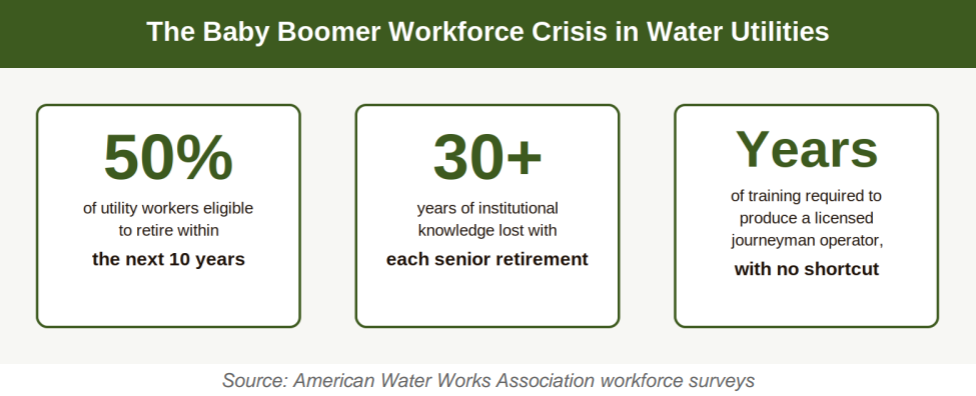
in its history. The American Water Works Association estimates that approximately 30 to 50
percent of the utility workforce will reach retirement age within the next decade. These are not
entry-level positions being vacated. These are the experienced, licensed operators and
maintenance professionals who carry decades of institutional knowledge, most of it stored not
in any manual or database, but in their heads.
The Baby Boomer generation, those born between 1946 and 1964, has driven the skilled
trades workforce for the better part of four decades. As this generation exits the workforce in
large numbers, utilities are discovering a painful truth: there is no simple replacement waiting
in line.
The pipeline of qualified water and wastewater operators has not kept pace with demand.
Licensed operators must meet increasingly rigorous state certification requirements, and the
training pipeline takes years to produce a journeyman-level professional. Meanwhile, younger
workers entering the trades have more career options than any previous generation, and
utility work, often unglamorous and geographically tied to small communities, must compete
for talent against industries offering remote work, higher entry-level pay, and faster
advancement.
For small and rural utilities, this challenge is especially acute. A city of 3,000 people cannot
offer the career ladder that a metropolitan utility system can. When a key operator leaves,
there may be no experienced backup. The institutional knowledge gap can become a safety
and compliance gap almost overnight.
What Gets Lost When Experience Walks Out the Door
Think about what an experienced operator actually knows, and how little of it is captured in a
traditional paper O&M manual.
They know that the chlorine residual tends to drop at the far end of the distribution system on
summer Fridays because demand spikes and flushing slows down. They know that the
standby generator needs an extra 90 seconds to stabilize before it can carry full load. They
know which valves are stiff, which pressure gauges read consistently low, and which alarm
has been false-triggering for three years because of a corroded sensor nobody has gotten
around to replacing.
A traditional O&M manual, even a well-written one, captures the baseline: process flows,
equipment specs, emergency procedures, chemical handling instructions. It does not capture
the living, accumulated wisdom that separates a well-run system from one that is constantly in
reactive mode.
When that experienced operator leaves, the new hire gets the manual. What they don't get is
30 years of context.
The Electronic O&M Manual: A Step Forward, But Not Enough
The industry has been moving toward electronic O&M manuals for good reason. Digital
documents are easier to update, easier to search, and can incorporate photos, diagrams, and
video in ways that binders never could. Regulatory agencies, including the Texas Commission
on Environmental Quality, have increasingly encouraged utilities to maintain current,
accessible operational documentation.
But a static electronic document, even a well-organized one, still has the same fundamental
limitation as its paper predecessor. It answers the questions someone thought to ask when
the document was written. It does not adapt to the question a new operator is asking at 2:00 in
the morning when an alarm sounds and no one else is available.
This is where AI-enhanced electronic O&M manuals represent a genuine leap forward.

What an AI-Enhanced eO&M Manual Actually Does
An AI-enhanced electronic O&M manual is not simply a PDF with a search bar. It is a
dynamic, interactive knowledge platform built specifically around your system, your
equipment, your operating conditions, and your regulatory requirements.
A new operator receives an alert that turbidity at the filter effluent has spiked. Instead of
flipping through pages of a manual looking for the right section, or calling the retired operator
at home, they open the eO&M system and describe what they are seeing. The AI guidance
engine, trained on your facility's specific documentation, draws from filter operation
procedures, backwash sequences, source water quality records, and regulatory thresholds to
walk the operator through a logical troubleshooting process. It asks clarifying questions. It
flags potential causes in order of likelihood based on your system's history. It reminds the
operator of the notification requirements if the situation escalates to a reportable event.
The system does not replace the operator's judgment. It supports it. And it does so at any
hour, for any operator, regardless of how long they have been on the job.
Beyond troubleshooting, an AI-enhanced eO&M manual can serve as a continuous training
tool, embedding regulatory context directly into operational guidance so that operators
understand not just what to do, but why. It can surface relevant safety information at the
moment it is needed. It can be updated in real time as procedures change, equipment is
replaced, or regulations evolve, without requiring a manual reprint or a staff meeting to
communicate the change.

Why This Matters More Than Ever
The convergence of retiring Baby Boomers and a shrinking labor pool has created a situation
where utilities can no longer afford to depend on human memory as their primary knowledge
management strategy.
An AI-enhanced eO&M manual is not a luxury or a technology experiment. It is an institutional
continuity tool. It is the way a utility protects itself when its most experienced people leave. It is
the way a small system with limited staff can operate safely and compliantly even when
qualified backup is not available. It is the way a new operator can get up to speed faster
without sacrificing safety or regulatory standing.
For communities that depend on safe, reliable water and wastewater service, the stakes could
not be higher. A compliance failure, a contamination event, or an equipment failure caused by
a knowledge gap is not just an operational problem. It is a public health problem.
LSPS Solutions and the Recognition That Followed
At LSPS Solutions, we have spent years working alongside small and rural Texas utilities, and
we have seen the knowledge gap crisis firsthand. That experience drove us to develop what
we believe is a better answer: a Digital O&M Manual with Embedded AI Guidance, built
specifically for the scale and reality of small municipal water and wastewater systems.
We built our first AI-enhanced eO&M Manual for the Brazosport Water Authority in Lake
Jackson, Texas. That project became the foundation for a service offering we are proud to
bring to utilities across the state.
We are equally proud to share that Fast Company, one of the most respected business
publications in the country, recently selected our AI-enhanced Digital O&M Manual as an
Honorable Mention in their 2026 World Changing Ideas Awards. For a small consulting firm
based in Victoria, Texas, competing alongside well-funded startups and large national
organizations, that recognition means something. It confirms that the problem we are solving
is real, and that the solution we have built is genuinely innovative.
The award was publicly announced on June 16, 2026, on fastcompany.com, with select
honorees also featured in Fast Company's Summer print issue on June 23, 2026.
The Time to Act Is Now
If your utility is facing retirements in the next one to five years, the time to begin capturing and
organizing that institutional knowledge is not after the experienced operator leaves. It is now,
while that person is still available to contribute to the process.
An AI-enhanced eO&M manual does not build itself overnight. It requires a thoughtful
documentation process, a site-specific understanding of your system, and careful integration
of your operational procedures, equipment records, and regulatory context. The sooner that
process begins, the more institutional knowledge can be preserved before it walks out the
door.
LSPS Solutions works with utilities to evaluate their current documentation, identify
knowledge gaps, and build eO&M systems that are practical, affordable, and tailored to small
system realities. We welcome the conversation.
Lynn Short is the President and CEO of LSPS Solutions, LLC, a municipal and public works consulting firm headquartered in Victoria, Texas. LSPS Solutions serves small and rural Texas utilities with services including utility operations evaluations, rate studies, corrosion control studies, GIS mapping, and AI-enhanced operational tools. To learn more or schedule a consultation, visit www.lspssolutions.com or call 361-212-8243.


