The Hidden Cost of “Doing Nothing”: How Municipalities Are Quietly Falling Behind on Compliance
In municipal government, failure rarely happens all at once. It does not show up as a catastrophic breakdown or a missed deadline that triggers immediate consequences. Instead, it accumulates quietly through small delays, outdated processes, and competing priorities. Over time, this slow drift creates a gap between what is required and what is actually being done. That gap is where compliance risk lives.

Most cities are not actively choosing to ignore regulations. In fact, the opposite is true. Staff are often aware of requirements tied to frameworks like the America’s Water Infrastructure Act, Lead and Copper Rule revisions, and various state-level mandates. The issue is not awareness. It is execution under constrained resources.
Compliance in municipal environments is inherently complex. Requirements are spread across federal, state, and local levels. They evolve frequently. They require documentation, reporting, and often coordination across multiple departments. Even for well-run cities, staying fully aligned requires a level of operational discipline that is difficult to maintain over time.
The result is a form of passive noncompliance. Not intentional, not negligent in the traditional sense, but structurally inevitable given how most municipalities operate.
The first driver of this drift is fragmentation. Compliance responsibilities are rarely centralized. A water utility may handle certain reporting requirements, while public works manages others, and administrative staff handle documentation and filings. Each group operates within its own systems, often with limited visibility into the full compliance landscape. When requirements overlap or change, there is no single source of truth.
This fragmentation leads to inconsistencies. One department may be meticulous, while another is operating on outdated templates or assumptions. Over time, these inconsistencies compound. A missed update here, an outdated procedure there, and suddenly the organization is no longer aligned with current regulatory expectations.
The second issue is process dependence on institutional knowledge. Many municipalities rely heavily on long-tenured staff who “know how things are done.” While this experience is valuable, it creates a vulnerability. When processes are not formally documented or updated, they become static. Regulations, however, do not remain static.
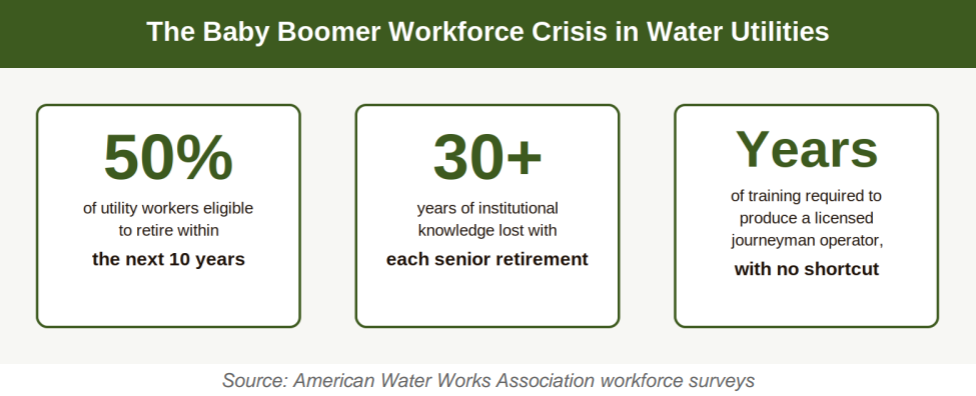
When a key staff member retires or transitions out, that knowledge often leaves with them. The incoming staff inherit a set of processes that may or may not reflect current requirements. Without a systematic way to validate and update those processes, the organization begins to drift further out of compliance.
The third factor is the sheer administrative burden of compliance. Reporting requirements are often time-consuming and detail-oriented. They require gathering data from multiple sources, verifying accuracy, and formatting it according to specific standards. For departments that are already understaffed, compliance work competes directly with operational priorities.
In practice, this creates a triage environment. Immediate operational issues take precedence, as they should. Compliance tasks are pushed to the side until they become urgent. By the time they are addressed, deadlines are tighter, data is harder to compile, and the likelihood of errors increases.
This is where the hidden cost emerges. On the surface, nothing appears broken. The city continues to operate. Services are delivered. Residents are not immediately affected. But beneath that surface, risk is accumulating.
Regulatory risk is the most obvious. As requirements tighten, the margin for error decreases. A city that was previously “close enough” may suddenly find itself out of alignment. This can lead to penalties, increased scrutiny, or mandated corrective actions, all of which require time and resources to address.
There is also financial risk. Noncompliance can affect eligibility for grants and funding programs. Many federal and state funding opportunities require demonstration of compliance as a prerequisite. Falling behind does not just create penalties. It limits access to future resources.
Operational risk is another dimension that is often overlooked. Compliance requirements are not arbitrary. They are typically tied to safety, reliability, and long-term infrastructure performance. When compliance processes are weak, it is often a signal that underlying operational processes may also be inconsistent. This increases the likelihood of service disruptions or infrastructure failures over time.
Finally, there is reputational risk. Municipal governments operate on public trust. When compliance issues surface, whether through audits, reporting discrepancies, or public records requests, they can erode confidence in leadership and operations. Even minor issues can become amplified if they suggest a pattern of disorganization or neglect.
What makes this problem particularly challenging is that it does not lend itself to simple solutions. Hiring more staff is not always feasible. Adding more software does not automatically fix fragmented processes. In many cases, municipalities have already invested in tools that are underutilized or poorly integrated.
The core issue is not a lack of effort or intent. It is a lack of systems.
Addressing compliance drift requires a shift from reactive to structured operations. This starts with centralizing visibility. Municipalities need a clear, consolidated view of their compliance obligations, including what is required, when it is due, and who is responsible. Without this baseline, it is impossible to manage effectively.
Next is standardization. Processes for meeting compliance requirements should be documented, repeatable, and regularly reviewed. This reduces dependence on individual knowledge and creates consistency across departments. It also makes onboarding new staff significantly more efficient.
Automation can play a role, but only when layered onto well-defined processes. For example, automating reminders for reporting deadlines is useful, but only if the underlying data collection process is reliable. Similarly, tools that allow staff to quickly access relevant regulatory information, such as Rule-Trace can reduce the time spent searching through dense documentation, but they need to be integrated into daily workflows to be effective.
There is also an opportunity to rethink how compliance work is positioned internally. Instead of being treated as an administrative burden, it should be framed as a core operational function. When compliance is embedded into routine processes rather than handled as an afterthought, it becomes more manageable and less disruptive.
For many municipalities, the path forward is incremental. It does not require a complete overhaul. It requires identifying the highest-risk areas, establishing clearer processes, and building from there. Even small improvements in visibility and consistency can have a meaningful impact over time.
The key point is that doing nothing is not a neutral choice. It carries a cost, even if that cost is not immediately visible. Compliance drift is gradual, but its consequences are real.
Cities that recognize this dynamic early have an advantage. They can address gaps before they become liabilities. They can position themselves to access funding, maintain operational stability, and build trust with regulators and the public.
Those that do not may continue operating as usual for some time. But eventually, the gap between expectation and reality will surface. And when it does, the cost of catching up is almost always higher than the cost of staying aligned in the first place.