Is Your Water Quietly Corroding Your Pipes? LSPS Solutions Introduces Real-Time Corrosion Monitoring
New corrosion monitoring technology helps Texas water utilities measure corrosion rates, evaluate treatment effectiveness, and strengthen lead and copper compliance efforts.
Water quality is about more than what leaves the treatment plant. It's also about what happens to that water as it travels through distribution pipes, service lines, and household plumbing.

Even water that meets applicable treatment and quality standards can interact with metal surfaces, potentially causing corrosion over time.
For water utilities, this presents a significant challenge.
Corrosion can contribute to the release of lead and copper from plumbing materials, accelerate infrastructure deterioration, and create water quality concerns that are difficult to diagnose.
And unlike a broken water main or visible leak, corrosion often develops quietly, without obvious warning signs.
The challenge is that many utilities don't have a practical way to measure how quickly corrosion is occurring or determine whether their corrosion control treatment is actually working.
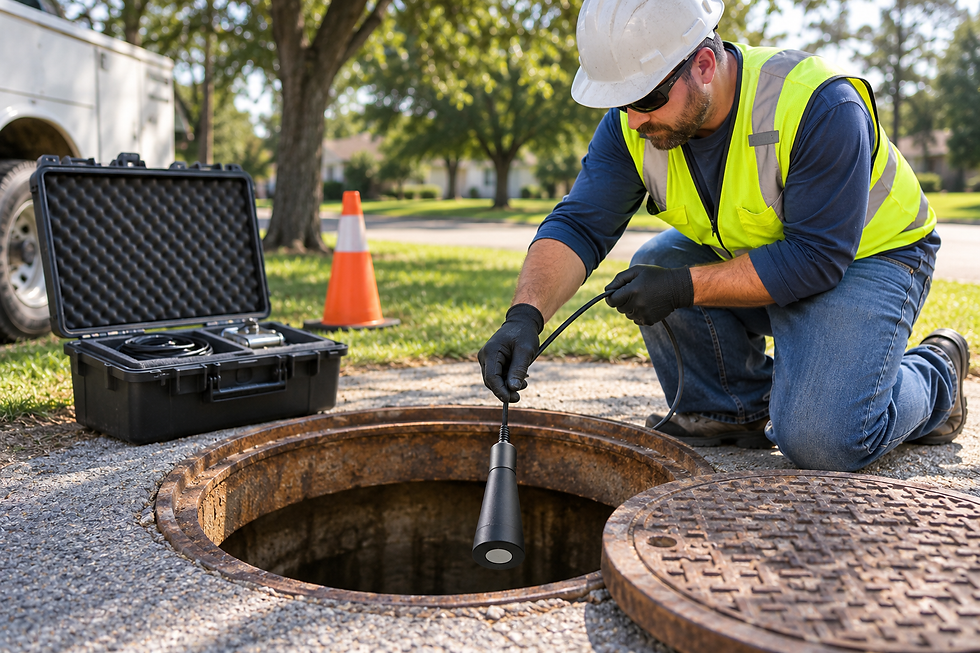
To help Texas utilities address this challenge, LSPS Solutions has expanded its field services capabilities with the addition of four InstantMPY CM2012 linear polarization resistance (LPR) corrosion monitors.
This equipment allows our team to measure metal corrosion rates in real time, evaluate treatment changes, and provide utilities with documented information to support corrosion control studies and regulatory compliance.
It's another step in our commitment to bringing specialized equipment, technical expertise, and practical solutions to small and rural Texas water utilities.
The Hidden Problem of Corrosion in Drinking Water Systems
Corrosion is a natural electrochemical process that occurs when metals interact with their surrounding environment.
In drinking water systems, corrosion can affect distribution mains, service lines, plumbing fixtures, and other metal components that come into contact with water.
The rate and severity of corrosion depend on several factors, including water chemistry, temperature, dissolved oxygen, pipe materials, and treatment conditions.
Changes in pH, alkalinity, or other water quality characteristics can influence how aggressively water interacts with metal surfaces.
For utilities, the consequences can extend well beyond pipe deterioration.
Corrosion can contribute to:
Lead and copper release: Corrosion of lead-containing service lines, solder, and plumbing materials can increase lead concentrations, while copper plumbing corrosion can contribute to elevated copper levels.
Infrastructure deterioration: Corrosion can shorten the useful life of metal pipes, fittings, meters, and other components.
Water discoloration: Corrosion products can contribute to discolored water and customer complaints.
Higher maintenance costs: Deteriorating infrastructure may require more frequent repairs or earlier replacement.
Regulatory concerns: Elevated lead or copper levels can trigger additional monitoring, treatment evaluations, and regulatory requirements.
For smaller water systems operating with limited budgets, these challenges can create significant financial and operational pressure.
The problem isn't simply that corrosion occurs. It's that utilities need reliable information to understand how their water chemistry and treatment decisions affect corrosion.
Why Traditional Corrosion Testing Can Be Challenging
Utilities have several methods available to evaluate corrosion and its potential effects.
Lead and copper sampling is an essential part of drinking water compliance, providing information about metal concentrations at selected customer taps.
However, these samples don't directly measure the instantaneous corrosion rate of metal exposed to the water.
Traditional corrosion coupon testing provides another useful approach.
In a coupon study, a metal sample is exposed to water over an extended period. After the exposure period, the sample is evaluated to determine how much material has been lost.
This can provide valuable information about average corrosion rates, but results may take weeks or months to obtain.
That creates a challenge when utilities need to evaluate treatment changes.
Consider a utility testing a new corrosion inhibitor.
If the utility relies exclusively on long-duration testing, it may take considerable time to determine whether the treatment is reducing corrosion.
During that period, operators may have limited information about whether the selected chemical or dosage is appropriate.
What if utilities could measure corrosion rates directly and observe how those rates change as treatment conditions change?
That's where linear polarization resistance technology provides an important advantage.
Introducing Real-Time Corrosion Monitoring
LSPS Solutions has invested in four InstantMPY CM2012 linear polarization resistance corrosion monitors, allowing our field services team to measure corrosion rates directly in flowing water samples.
Linear polarization resistance, commonly called LPR, is an established electrochemical technique used to evaluate the corrosion behavior of metals.
The equipment uses a specialized probe containing metal electrodes that are exposed to the water being evaluated.
During a measurement, the instrument applies a very small electrical potential across the electrodes and measures the resulting electrical response.
This information is used to calculate polarization resistance, which can then be converted into an estimated corrosion rate.
Results are expressed in mils per year (mpy), a standard unit used to describe the rate of metal thickness loss due to corrosion.
One mil represents one-thousandth of an inch.
Unlike traditional coupon testing, which provides an average corrosion rate after an extended exposure period, LPR monitoring can provide a reading in approximately one minute.
This allows our team to collect measurements repeatedly throughout a study and evaluate how corrosion behavior changes over time.
For utilities, that means access to much more immediate information about how their water interacts with the metals being tested.
Measuring the Impact of Treatment Changes
One of the most valuable applications of real-time corrosion monitoring is evaluating the effectiveness of corrosion control treatment.
Water utilities may adjust pH, alkalinity, or chemical treatment to improve water stability and reduce corrosion concerns.
However, selecting the appropriate treatment approach isn't always straightforward.
Water chemistry varies between systems, and a treatment strategy that performs well in one utility may not produce the same results in another.
For example, a utility considering an orthophosphate-based corrosion inhibitor may need to determine whether the product is effective in its particular water and what dosage provides the desired response.
Without timely performance data, making these decisions can be difficult.
LPR monitoring provides another tool for evaluating treatment effectiveness.
By collecting corrosion measurements before and after treatment adjustments, utilities can observe how the measured corrosion rate responds.
This can help answer important questions:
Is the selected treatment reducing the measured corrosion rate?
How does corrosion respond to changes in pH or alkalinity?
Does increasing an inhibitor dosage produce a meaningful additional benefit?
How do different water sources compare?
Are corrosion conditions changing as treatment adjustments are implemented?
These measurements can help guide treatment evaluations and chemical dosing decisions.
For utilities considering significant changes to their treatment programs, this information can be particularly valuable.
Rather than relying exclusively on theoretical expectations or waiting for the next round of compliance sampling, utilities can collect additional performance data during the evaluation process.
Importantly, LPR measures corrosion behavior at the test electrodes. It does not directly measure lead or copper concentrations at customer taps and does not replace required compliance sampling.
Instead, it provides complementary information that can strengthen the overall corrosion control evaluation.
Comparing Multiple Water Sources and Treatment Options
Water utilities frequently face operational decisions involving different water sources.
A system may add a new well, begin blending water from multiple sources, or change treatment processes to address capacity or water quality needs.
These decisions can affect water chemistry and, potentially, corrosion behavior.
Two water sources that individually meet drinking water standards may have different chemical characteristics.
When blended, those characteristics can change the conditions experienced by metal surfaces throughout the distribution system.
LSPS's investment in four corrosion monitors allows our team to evaluate multiple locations or water samples simultaneously.
For example, we can compare corrosion rates at different water sources, monitor several points within a distribution system, or evaluate a treated sample alongside an untreated control.
This side-by-side approach can help utilities understand how different operating conditions influence corrosion.
It can also support decisions about treatment adjustments before changes are implemented more broadly.
For smaller systems that depend on multiple wells or are considering new water sources, these comparisons can provide valuable information for planning and operational decision-making.
Supporting Lead and Copper Compliance
Corrosion control plays an important role in protecting drinking water quality.
Lead and copper can enter drinking water when plumbing materials containing these metals corrode.
Because lead exposure presents significant public health concerns, drinking water regulations establish requirements for monitoring and controlling lead and copper.
When a utility experiences a lead or copper action level exceedance, additional regulatory requirements may apply, potentially including corrosion control evaluations and treatment recommendations.
For Texas utilities, these requirements are administered through the Texas Commission on Environmental Quality (TCEQ) under applicable federal and state drinking water regulations.
A corrosion control study may involve evaluating water chemistry, existing treatment practices, potential corrosion inhibitors, and other factors influencing metal release.
Real-time corrosion monitoring can strengthen this process by providing additional information about how metals respond to different water conditions.
For example, LSPS can use LPR measurements to compare corrosion rates before and after changes to treatment chemistry.
These findings can help support treatment recommendations and provide documentation for regulatory review.
The ability to observe corrosion behavior over time gives utilities another source of evidence when evaluating corrosion control strategies.
However, corrosion rate measurements are only one component of a comprehensive corrosion control study.
Lead and copper compliance continues to depend on the applicable regulatory sampling, monitoring, and treatment requirements.
LPR data complements these activities rather than replacing them.
Real-World Experience: Supporting a Texas City's Corrosion Control Study
This new equipment is more than an investment in future capabilities.
LSPS Solutions has already applied InstantMPY CM2012 corrosion monitoring technology during a TCEQ-required corrosion control study for a Texas municipality.
As part of that project, our team monitored corrosion rates daily at four locations while evaluating corrosion inhibitor performance.
By collecting measurements throughout the evaluation period, LSPS was able to observe how corrosion rates responded under the study conditions.
This approach provided additional technical information to support the corrosion control evaluation and treatment recommendations.
The project demonstrates how real-time corrosion monitoring can be incorporated into an actual utility compliance study rather than functioning solely as a laboratory or research tool.
With four monitors now available in-house, LSPS can conduct similar evaluations for other Texas utilities without depending on rented equipment or outside vendor availability.
Better Information for Infrastructure Protection and Long-Term Planning
Although lead and copper compliance is an important reason to evaluate corrosion, the benefits of corrosion monitoring extend beyond regulatory requirements.
Corrosion can also affect the long-term performance and reliability of water infrastructure.
Metal distribution mains, service lines, fittings, and meters can deteriorate over time when exposed to corrosive conditions.
While corrosion rates vary considerably depending on material and operating conditions, reducing excessive corrosion can help protect infrastructure and potentially extend equipment service life.
For utilities managing aging systems, this has important financial implications.
Replacing water mains and service lines can require substantial capital investment.
Understanding how water chemistry affects corrosion can help utilities make more informed decisions about treatment practices and infrastructure protection.
Real-time corrosion monitoring can support:
Treatment optimization. Evaluate how chemical treatment adjustments affect measured corrosion rates.
Infrastructure protection. Identify conditions that may contribute to accelerated metal deterioration.
Water source evaluations. Compare corrosion behavior when introducing or blending different sources.
Capital planning. Incorporate corrosion-related information into broader infrastructure management decisions.
Operational documentation. Maintain records of corrosion measurements to support treatment evaluations and future investigations.
For utilities seeking to maximize the useful life of existing infrastructure, this information can contribute to a more proactive approach to asset management.
Connecting Corrosion Monitoring with LSPS's Existing Services
At LSPS Solutions, we believe the most effective utility solutions combine reliable field data with practical technical expertise.
Our new corrosion monitoring capability directly complements the corrosion control studies, water quality evaluations, and TCEQ compliance support we already provide.
Rather than functioning as an isolated service, LPR monitoring strengthens our ability to evaluate treatment options and develop recommendations based on actual measurements.
The information collected can support treatment studies, chemical dosing evaluations, and technical reports prepared for regulatory review.
Monitoring locations and findings can also be incorporated into a utility's Geographic Information System (GIS) and asset management records.
For utilities using platforms such as Diamond Maps, corrosion monitoring locations can be documented alongside lead and copper sampling sites and other infrastructure information.
This helps create a more complete picture of system conditions and provides a useful record for future evaluations.
Our corrosion monitoring equipment joins an expanding portfolio of specialized field services, including:
Water meter accuracy testing
Continuous water pressure monitoring
CCTV sewer inspection and defect locating
Wastewater flow monitoring and I&I detection
Sanitary sewer smoke testing
Valve maintenance
Aerial drone inspections
By investing in specialized equipment and making these capabilities available as services, LSPS helps small and rural Texas utilities access tools and expertise they may not be able to justify purchasing independently.
Our goal isn't simply to provide more measurements.
It's to help utilities turn reliable data into better treatment decisions, stronger compliance documentation, and more effective infrastructure management.
Do You Know How Corrosive Your Water Really Is?
Your utility may be meeting its current operating targets, but how is your water interacting with the metal components throughout your system?
Is your corrosion control treatment performing as expected?
Could a different inhibitor or dosage produce better results?
And if you're planning to introduce a new water source or modify treatment conditions, how might those changes affect corrosion?
Without direct corrosion monitoring, these questions can be difficult to answer.
With our new fleet of InstantMPY CM2012 corrosion monitors, LSPS Solutions can help your utility evaluate corrosion behavior in real time, compare treatment options, and make more informed water quality decisions.
Whether you're responding to a lead or copper action level exceedance, preparing a corrosion control study, evaluating treatment changes, or investigating rising copper concentrations, our team is ready to help.
Don't wait months to learn whether your corrosion control strategy is working.
Contact LSPS Solutions today to discuss a corrosion monitoring assessment, request a corrosion control study proposal, or learn how our expanded field services can support your utility.
LSPS Solutions — Practical Expertise. Reliable Data. Stronger Utilities.