AI in Texas Government: Regulation, Reality, and How Municipalities Can Use AI Responsibly Today
Artificial intelligence has become one of the most misunderstood technologies in public-sector conversations. Depending on who you ask, AI is either an unstoppable force that will replace government workers or a dangerous technology that should be avoided entirely. In Texas, this confusion has led to a persistent myth that the state has adopted an anti-AI stance or has banned the use of artificial intelligence in government operations. That is simply not true. In reality, Texas is taking a pragmatic, structured approach to AI that emphasizes responsible use, human oversight, and clear guardrails while still encouraging innovation across state and local government.

This distinction matters, especially for municipal governments. Cities, counties, utilities, and special districts are facing increasing regulatory pressure, shrinking workforces, and growing expectations from residents. AI is not a silver bullet, but when used correctly, it can meaningfully reduce administrative burden, improve compliance, and free staff to focus on higher-value work.
Understanding how Texas regulates AI and how the state itself is using these tools provides a clear roadmap for municipalities that want to move forward confidently rather than sit on the sidelines.
Texas Does Not Ban AI. It Regulates It.
Texas has not adopted a blanket prohibition on artificial intelligence. Instead, the state has focused on defining what constitutes acceptable and unacceptable use. The cornerstone of this approach is the Texas Responsible Artificial Intelligence Governance Act, which establishes guardrails around high-risk and harmful applications while explicitly allowing responsible use across government. The intent is not to slow innovation, but to prevent discrimination, manipulation, lack of transparency, and unchecked automation in decision-making that affects people’s rights or access to services.
Importantly, the law does not prohibit AI tools for internal operations, analytics, document processing, or decision support. It also does not require municipalities to stop experimenting with AI. What it does require is thoughtful deployment, clear accountability, and human oversight. In other words, Texas is signaling that AI should be treated like any other powerful operational tool, governed by policy rather than fear.
Oversight and guidance for state agencies flows primarily through the Texas Department of Information Resources, which sets technology standards and procurement guidance for Texas government entities. DIR’s role is not to block AI adoption, but to help agencies understand risks, evaluate vendors, and implement tools responsibly.
State Leadership on AI: Setting the Tone
To reinforce this balanced approach, Texas appointed its first Chief AI and Innovation Officer, Tony Sauerhoff. This role exists specifically to help agencies navigate AI adoption in a way that is secure, ethical, and operationally sound. The creation of this position sends a clear message: Texas expects AI to be used, but used well.
At the state level, AI is already being applied in areas such as cybersecurity monitoring, document classification, data analysis, and internal process optimization. These uses are largely invisible to the public, which is by design. The goal is not flashy automation, but quieter efficiency gains that reduce manual work and improve consistency. This same philosophy is directly applicable to municipal governments, which often have fewer resources but similar operational challenges.
How Texas Government Is Actually Using AI
Despite the rhetoric, Texas agencies are not using AI to replace staff or make autonomous policy decisions. Instead, AI is being used as a support layer. For example, agencies use machine learning to identify anomalies in large datasets, assist with threat detection in cybersecurity, and help staff find relevant information more quickly across massive document repositories. AI systems flag issues, summarize information, and surface insights, but humans remain responsible for final decisions.
This is an important distinction for municipal leaders. Responsible AI in government is not about handing over authority to algorithms. It is about reducing friction in everyday work. When staff spend less time searching for documents, re-entering data, or manually compiling reports, they can spend more time on planning, stakeholder engagement, and service delivery.
Why Municipal Governments Are a Natural Fit for AI
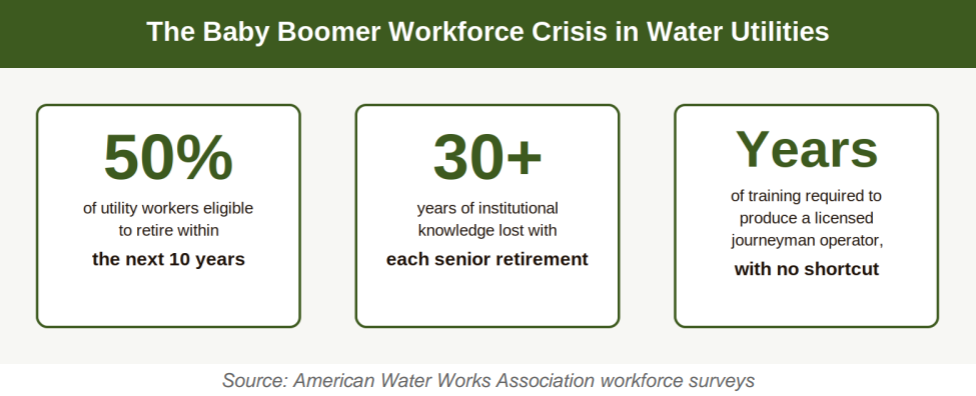
Municipal governments are under pressure from multiple directions. Regulatory requirements are increasing, especially in areas like water, wastewater, environmental compliance, procurement, and public records. At the same time, many cities are dealing with retirements, hiring challenges, and limited budgets. The result is a workload that keeps growing while staff capacity stays flat or declines.
AI is particularly well suited to this environment because much of municipal work is document-heavy, rules-based, and repetitive. Council packets, ordinances, meeting minutes, inspection reports, compliance documentation, standard operating procedures, and asset records all follow predictable patterns. AI excels at working with this kind of structured and semi-structured information when it is properly trained and constrained.
Practical AI Use Cases for Cities and Utilities
The most effective municipal AI projects tend to start internally rather than facing the public directly. One common use case is summarizing and organizing large volumes of information. AI can generate accurate summaries of council agendas, meeting minutes, staff reports, and regulatory correspondence, allowing leaders and managers to absorb key points quickly without reading hundreds of pages. This does not replace the official record, but it makes that record far more usable, especially for city managers, department heads, and elected officials who are already time constrained.
Another high-value application is internal question answering. When staff need to know which policy applies, what a regulation requires, or how a process works, AI can provide instant answers based on the city’s own documents. This is the same concept behind AI-powered internal chatbots and AI O and M manuals, where institutional knowledge, operating procedures, and regulatory requirements are centralized and made searchable through natural language rather than buried across binders, PDFs, and shared drives. For cities dealing with retirements, turnover, or understaffed departments, this alone can dramatically reduce onboarding time and reliance on a handful of long-tenured employees.
AI can also support compliance management by tracking deadlines, flagging missing documentation, and identifying gaps before they become findings. In utilities, this often shows up through AI-assisted asset management and compliance tools that connect maintenance records, inspections, operating data, and regulatory requirements into a single system of record. Instead of reacting to compliance issues after the fact, staff can proactively see where risks are emerging and prioritize work accordingly. These systems support better decisions without taking decision-making authority away from staff.
Drafting is another area where AI delivers immediate value. First-pass drafts of reports, SOPs, grant narratives, public notices, capital planning documentation, and internal memos can be generated quickly, with staff reviewing, refining, and approving the final output. When combined with an AI O and M manual or document-trained assistant, this drafting is grounded in the city’s actual standards and practices rather than generic templates. For small and mid-sized municipalities, this can save dozens or even hundreds of hours per year while improving consistency across departments.
Best Practices for Responsible Municipal AI Adoption
The difference between successful AI adoption and failed experiments usually comes down to governance and scope. One best practice is to start with clearly defined, low-risk use cases that are internal-facing. Avoid automating public decisions or enforcement actions early on. Focus instead on saving staff time.
Human oversight is non-negotiable. AI outputs should always be reviewed by a qualified employee, especially when they relate to compliance, policy, or public communication. Clear ownership should be established so it is always obvious who is responsible for decisions.
Another critical practice is grounding AI systems in authoritative local data. Municipal AI should be trained or constrained using the city’s own ordinances, policies, manuals, and regulations, not the open internet. This dramatically reduces hallucinations and ensures outputs reflect local reality.
Documentation and training also matter. Staff should know what tools are being used, what they are allowed to use them for, and what their limitations are. Banning AI outright often drives usage underground. Clear guidance builds trust and consistency instead.
Finally, municipalities should treat AI as a workforce multiplier, not a workforce replacement. The goal is to help experienced employees do more with less friction, preserve institutional knowledge, and reduce burnout. AI works best when paired with human judgment and local expertise.
The Bottom Line for Texas Municipal Leaders
Texas is not telling cities to avoid AI. It is telling them to use it responsibly. The state’s regulatory framework, leadership appointments, and internal adoption all point to a future where AI becomes a standard operational tool, much like GIS, asset management systems, or document management platforms.
For municipal governments, the question is no longer whether AI will be part of daily operations, but whether it will be adopted intentionally or reactively. Cities that start now, with clear guardrails and practical use cases, will be better positioned to handle regulatory complexity, staffing challenges, and rising expectations without overextending their teams. AI, when used thoughtfully, is not a risk to good government. It is a tool to help it function better.
If your organization is interested in exploring how AI can be implemented safely and effectively within your specific municipal environment, whether for water and wastewater utilities, code enforcement, public works, or city management offices, LSPS Solutions works directly with local governments to design practical, governance-aligned AI solutions tailored to real operational needs. We regularly provide executive briefings and staff-level presentations that focus on realistic use cases, risk management, and measurable workload reduction. If you would like a customized discussion or presentation for your team, we would be happy to collaborate with you to identify where AI can deliver the most value for your organization.